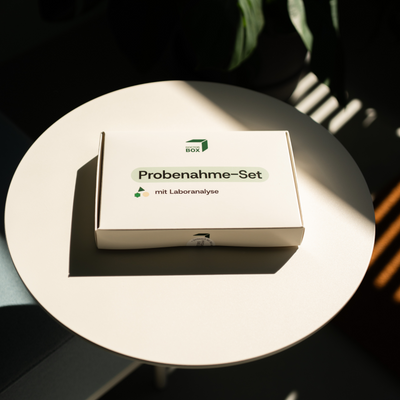


Colorectal cancer is one of the most common cancers – and at the same time one of the diseases where preventive care can be particularly effective.
Because bowel cancer usually develops slowly from precursor stages that often cause no symptoms for a long time.
This article provides an overview of the most important preventative care options: colonoscopy as the medical gold standard.
and modern tests that you can discreetly perform at home – including an explanation of which test answers which question.
Prevention · Gut health
Overview of colorectal cancer screening:
From colonoscopy to modern stool tests
Why colon cancer screening can be so effective
In many cases, colorectal cancer does not develop "suddenly". Often, benign precursors (e.g., polyps/adenomas) develop first. which can change over years. It is precisely this long development time that makes early detection so valuable.

Often asymptomatic for a long time
Early stages often cause no clear symptoms.

Early detection leads to better treatment
Any suspicious signs can be investigated further.

Planning is individual.
Age, risk, and life situation all play a role.
Colonoscopy: The medical gold standard
Colonoscopy is considered the most comprehensive method of colorectal cancer screening. The large intestine is examined directly and any abnormalities can – depending on the findings – be removed immediately or investigated further.
Why it is considered the gold standard
- Direct view into the intestines: changes can be visualized and classified.
- Polyps can often be removed directly: depending on the findings, frequently in the same step.
- Clear clarification: if tests reveal conspicuous indications, mirroring is often the next step.
At the same time, some people perceive the preparation, scheduling, or the procedure itself as a hurdle. Modern tests can help to make preventive care easier to start or more regular – without ignoring colonoscopy.
Modern home tests: Which test answers which question?
Home tests can make preventative care easier – especially if you don't (yet) want to have a colonoscopy. or if you want to supplement your preventative care. The crucial point is the classification: some tests provide indications of possible [issues]. Changes in the gut, others help to better understand personal risk.
Stool test
Basic early detection
Suitable for everyday use
Colorectal cancer screening test (iFOBT)
A proven stool test that can detect invisible blood – a possible indication, which (if noticeable) should be medically investigated.
It primarily answers the question: "Are there any indications of occult blood in the stool?"
What it's well suited for
- as a low-threshold entry point into preventive care
- as a routine check, because it can be easily repeated regularly
- if you want a clear, established method
Important in the classification
- An abnormal finding is not proof of diagnosis.
- Medical evaluation is then advisable (e.g., colonoscopy).
- Even unremarkable tests do not replace preventative care recommendations.
DNA stool test
Molecular genetic
Non-invasive
ColoAlert® DNA stool test
A modern, non-invasive DNA stool test for the early detection of colorectal cancer and precursors (e.g. polyps/adenomas) – with convenient sample collection at home.
It primarily answers the question: "Are there molecular genetic markers that can indicate early changes?"
What it's well suited for
- if you are looking for a more in-depth stool test option
- as a supplement, if a mirroring is not (yet) necessary
- if you want to implement preventative care discreetly and in a structured manner
Important in the classification
- Any unusual results should be medically evaluated.
- Colonoscopy remains the gold standard for diagnosis/removal
- The test can facilitate preventative care – but it does not replace medicine.
genetics
Risk profile
Long-term planning
AnteCRC (Antegenes) risk test
A genetic test via cheek swab that assesses your personal genetic risk . It does not show whether an illness is currently present – but it helps with preventative care planning.
It primarily answers the question: "What is my genetic risk – and how could I better plan my preventative care?"
What it's well suited for
- if you want to approach prevention strategically and in the long term
- if you want to better personalize your retirement planning decisions
- Possible as a guide even without a family history
Important in the classification
- no early detection test (no "yes/no" to colorectal cancer)
- helps with classification – medical care remains important
- Always consult a doctor if you experience any symptoms.
Important to know
Home tests can be a useful part of preventative care – however, they do not replace medical diagnosis. Any abnormal result should always be medically investigated (e.g., by means of a colonoscopy).
Conclusion: Prevention is not an either-or situation.
Colonoscopy remains the medical gold standard because it directly visualizes the colon and detects abnormalities. Depending on the findings, treatment may also be immediate. At the same time, it is perfectly understandable if people Not taking that step (yet): Preparation, scheduling, or simply uncertainty are real hurdles.
This is precisely where modern at-home tests can help: They make preventative care more accessible and bring the topic to the forefront. Back to everyday life – without pressure. A stool test can be a good start to avoid postponing preventative care. A DNA stool test This can be a more in-depth option if you want a modern, non-invasive approach. And a genetic one. A risk assessment can help you better plan your long-term preventative care – especially if you want to know whether an earlier [presumably referring to a specific procedure or treatment] is right for you. or a more closely spaced start might be useful.
It's important to remember: home tests are one piece of the puzzle – not a final diagnosis. If a result is abnormal or you have symptoms, A medical examination is the right next step. Ultimately, one thing matters most: preventative care that you actually take . Because the best plan is the one that fits your life.
Further information
- German Cancer Aid: Colorectal cancer screening – overview of stool tests & colonoscopy
- Cancer Information Service (DKFZ): Colorectal cancer – early detection & prevention options
- National Association of Statutory Health Insurance Physicians (KBV): Regulations on iFOBT & colorectal cancer screening
- Antegenes: AnteCRC – genetic risk assessment (PRS) and personalized prevention

